Friday, April 15, 2016

Busan: Cable car, horse racing, and more

Phillip and I are wrapping up our three full days in Busan, South Korea's second largest city. We have been so tired after our first few days that it was all I could do to transfer my pictures to the computer... then I just wanted to put my feet up and rest my legs. Today (Friday) was less taxing on our feet, so I am catching up on my blog.
Wednesday morning, we woke to a fairly steady rain. With umbrellas in hand, and a forecast from the hotel desk clerk that the rain would stop by 3 pm, we rode the subway to Centum City, a northern portion of Busan that is home to the Busan Cinema Center. This huge center hosts an annual international film festival and is an architectural masterpiece with swooping walkways (covered!) and film-related sculptures. While taking abreak from walking through the Center, we stopped at a cafe inside and I had a sweet potato latte. It was a fluid version of the best baked sweet potato with butter and cinnamon that I've ever had. Another recipe to find.

On our way back to the subway, we decided to find an ATM and get some more won. According to my phone, Citibank had two ATMs in the Shinsegae Department Store, which we had walked thru to get to the Cinema Center. Great! We would be dry in the store and could take care of a chore. We did not know when we started our quest that the Shinsegae Department Store in Centum City holds the Guiness world record as the largest department store in the world. A really nice young man, a student who knew a little English, asked if he could help us. I really wish I'd gotten his picture or name. This kid tried for almost 30 minutes, being told by clerks it was in one place, then another on a separate floor or side. He finally found us an ATM, but it wouldn't take our foreign card. He kept trying until we felt so bad for him and told him we apparently must go to a bank (we were tired and need a break!). Phillip and I finally got out of Shinsegae and found a bank about a block away that did take our card.
Our next stop was the United Nations Cemetary. This is the only UN cemetary in the world and is the final resting place for thousands of Korean War soldiers from 11 nations. We had been to the Korean War Memorial in Seoul, so this seemed to be a natural stop for us. We found the cemetary to be one of the best we have seen. The landscaping really created the proper respectful tone with the structure of the trees and shrubbery.
All the markers were granite and the graves were arranged by country with each country's flag flown above them. 
The cemetary also had a wall of remembrance where the names of every UN soldier, grouped by home country, who died in the war were listed. This granite etched wall circled around a reflecting pool with a fountain and flame.

As you can tell by Phillip's lack of umbrella, it did stop raining as the clerk had said, although there was still a slight drizzle as we walked all thru this cemetary and the 2 km back to the nearest subway stop.

Fortunately for us, the rain and clouds totally left the area Wednesday night so Thursday was nice for our cable car ride up Geumjeong Mountain. 
Notice how rugged the terrain looks under the cable car as we rode it up the mountain. I can't say we rode it to the top. as it does not go to the top. Four gates in a stone wall ring the top of the mountain. Our goal was to see the South Gate, the one nearest to the cable car arrival point. However, the signage was almost all in Korean. We wandered around on trails at the top until we saw a German couple who had been to the South Gate and told us how to get there. We had passed the trail cut-off twice but couldn't read the Korean sign. 
My Lonely Planet said it was a 10 minute walk from the cable car to the South Gate. We made it in about 30 minutes.
The four gates and stone walls were first erected during the three kingdoms period of Korean history, sometime between 57 AD and 668. The fortress, as it is called, went into disrepair but was rebuilt in 1707 to thwart invadors from Japan. These days, it is a popular hiking spot, although the hiking, like all hiking in Korea, is more akin to mountain climbing!
I posted the view of the terrain of the mountainside from the cable car. Here's a view of the terrain under the cable car at ground level. Yes, Phillip and I took an unmarked trail down the mountain. This picture is of one of the few spots where we weren't holding on to trees to keep from sliding on the pine needles. My thought was that the correct direction was down the incline, so as long as we didn't fall into a ravine, we were doing fine. And we did fine, although our knees and toes took a beating. I estimate that it took us about 90 minutes to work our way, zig-zagging, down the mountain, a journey that took 10 minutes up in the cable car. It was an adventure, making sure we were on some type of path and retracing when needed to avoid the big boulders and drop-offs. 
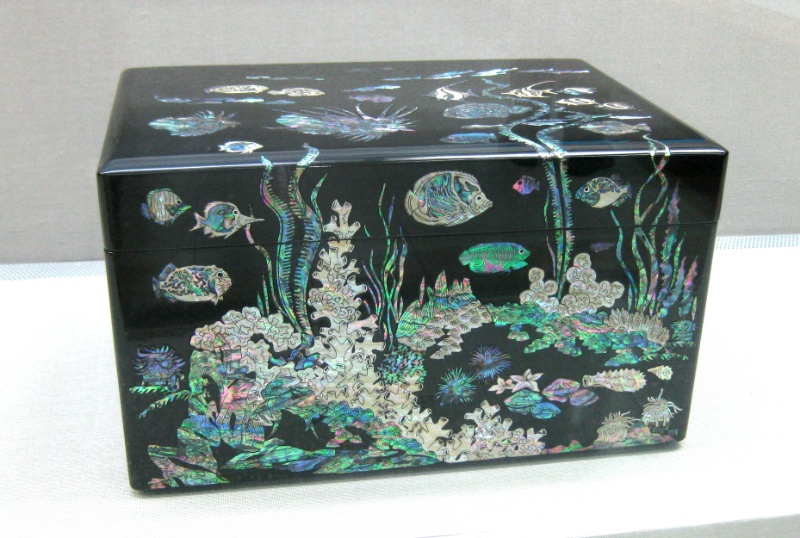
Back at the entrance to the fortress park, we had seen a sign for a hot spring, pointing to the north along the lower ring road. That seemed like a wonderful idea, so we started walking (uphill) with the thought of soaking our feet. We walked, but never found the hot spring. We did find a natural history museum that covered sea critters. We rested on the bench out front and decided to see what this free museum held. We skipped the fossil/rock exhibits as the Stone Park in Jeu had educated us. This museum had excellent displays of all manner of fish found in the waters around Korea. The most beautiful section was of the products from the sea, like the above mother of pearl inlayed chest on display.
The museum also had tanks of fish and live snake exhibits. The above fish is a piranha, but a type that looks as if someone sprinkled it with glitter.
Still hoping the hot springs were around the next corner, we kept walking and found a small botanic garden. The garden lured us in with a glimpse of colorful flowers. So, into this area, another beautiful landscape, terraced on the side of the mountain. Tulip beds and all manner of flowers awaited us, as well as a stream flowing over rocks with small bridges from which to admire the views. We ambled thru the lower portion of this park, but when we realized it extended even further up the mountain, our knees told us we had seen enough of the flowers. We gave up on finding the hot springs and headed back for the subway and our hotel.
During our final full day in Jeju, we decided to give our feet a relative rest and go to the horse races. (Our feet are never fully rested, as we walk to the subway and go up and down flights of stairs to get in and out of the subway - no escalators here). South Korea has three racing tracks, Seoul, Jeju, and Busan. We missed race day in Jeju (where they race Mongolian ponies) so we went to race day at Busan. A free shuttle bus took us from a subway stop to the race track outside the city. We were surprised by the number of small children in groups there, until we saw the children's amusement park that is a part of the track complex. Horse racing and preschool outings... not a mix we'd see at Lone Star Park!
The racing itself and the track were very similar to US horse racing set-ups. Most of the races were 1200 meters and the finish line was right in front of the grandstand. Between the actual Busan races, the facility simulcast the Jeju races on the big infield screens, so we were able to see the Mongolian ponies race, just not in person. The above picture is from one of the Busan races. 
Foreigners can wager on the races, so we picked one horse each for the five races we watched and bet the equivalent of about $2 on each our picks. Don't be fooled by the picture of our 2,400 won winnings. Remember that $1 = 1,100 Korean won. We bet about $20 and won about $2.50. OK, so we can't pick winning horses! We consider the $17.50 an investment in entertainment and our adventures. Phillip liked watching some of the Koreans bet big money on the horses and we enjoyed the crowd reactions as the races were actually being run. They match or exceed American race excitement and noise.

After watching 5 of the 10 races, we decided to head back to town. Unfortunately, the Busan racetrack website was a little incorrect. The free shuttles do not run all day. They stop when the racing starts and pick back up at 5:30 pm. It was 3:30 pm, so we took a taxi back to the nearest subway stop. No problem, but I did use the services of the free tourist information hotline to have someone call the racetrack and relay to me the actual shuttle schedule. 

I haven't been mentioning that every day, after all the walking we did, we'd walk from the hotel to the market and wander thru the market to find dinner at a restaurant or from street vendors. We actually wandered even farther from the hotel after our horse track day, to the seafood market. Acres and acres of vendors. It was similar to the Jeju fish market, only larger. It also had water running thru the tanks and into a drain track on the floor. I think this kept everything fresher - and alive longer - than the static tanks on Jeju. Phillip took video during our wanderings thru the market, so I'll put the picture I took of the docked fishing boats, bigger boats than those we saw at Jeju.
Although we were offered seafood for sale and one vendor told us in English that the restaurants upstairs would cook it for us, we didn't buy any today.

Our next adventure will be a train ride to Daegu, a city to the northwest of Busan, a four night stop on our way back to Seoul. Daegu has sights to see and a subway! We love subways. On to Daegu....


Tuesday, April 12, 2016

Final Jeju pictures and trotters in Busan

We arrived safely in Busan after our one hour flight from Jeju. Our Busan hotel is modern, with a steam sauna and heated, computerized  toilet with a bidet function in the bathroom and more significantly, a bed to sleep on. I'm certainly not complaining about our ondol room in Jeju, I chose to sleep for a week on the traditional Korean mat on the heated floor. Our hotel there, Hotel Dae Dong, actually had only five of those traditional rooms with the remainder being modern with beds. In addition to the experience of the ondol room, we really enjoyed chatting for the week with Eunhee Park and her brother, Jinseok. Eunhee had worked at several museums in the United States and developed ViaArt in Jeju, arranging art exhibits. ViaArt's space was adjacent to the hotel lobby.
 
The hotel had numerous paintings and lava rock displays. Eunhee said that the rock sculptures come from her father's collection and the paintings are either one's he had or ones she liked.  The hotel did an excellent job highlighting the features of Jeju. The painting above is of Hallasan, the mountain and UNESCO World Heritage sight that we did not climb while here.
I really liked the displays of the lava rocks, as here in the lobby. Sometimes, Eunhee's parents would staff the lobby, always smiling and greeting us. They actually had the hotel for several decades but are now mostly retired, leaving the operation to Eunhee and Jinseok. A very pleasant stay for us indeed.
Before we left Jeju, we decided to have the full restaurant experience of the island's signature dish, black pig, so we found a restaurant in Black Pig Street, easy to do because every building on the street is a restaurant. This picture doesn't show the multitude of sides and the soup we had, but it's a good picture of the pork as it grills at out table, surrounded by mushrooms, potato, onion and kimchee on the grill also.

In addition to the black pig and lava rock, Jeju is known for its citrus, specifically these tangerines, although all variety of orange citrus filled the Dongmun market. 
Every market sells every kind of kimchee: cabbage, radish, bean sprout, and many kinds we weren't sure of. Dongmun market didn't have just one or two vendors whose goods were displayed like this, it had dozens, just like the dozens of citrus vendors and fish vendors, and pork vendors, etc.
In Busan, after checking into our hotel, we went in search of the market area, which we found and it is huge! We also found Bupyeong-dong - Pigs' Feet Alley. That is what it is called on the map. The speciality of restaurants on that street is jokbal, translated on the menu as "pig trotters." So, we had pig trotters, above, for dinner last night. Tender pork meat, served thinly sliced and cold, with lettuce leaves and the multitude of sides to make your Korean burrito-like dinner. This pork had a milder, less intense flavor than our previous pork meal on Jeju, but still quite good and I'm glad we had our trotters.


Monday, April 11, 2016

Fish pictures without snorkling

Colorful, isn't it? This is a replica of the historic government building that was the center of administration of the island during the Joseon dynasty. The originalbuildings were destroyed by the Japanese when they invaded all of Korea in the early 1900s. My guidebook said there would be a martial arts demonstration, but with only about 6 visitors on the entire grounds, we decided the show wasn't going to happen, so we just walked around the displays.
This was the first museum/exhibit location that had mannequins, so I was actually startled when I stepped to the doorway of the first hall and came across guys like this.
After touring the historical displays and buildings, we walked to the ocean and  "Seafood Road." In old town Jeju City, one can find "Noodle Soup Road," Black Pork Road," and this one, "Seafood Road." Each building was a restaurant with tanks in front displaying the fish you pick out for your dinner. Since I won't be posting any snorkling pictures, here you go for fish pictures (abalone is the above shellfish):
Octopus is usually served raw or in soup here. Too chewy for us.
This one in the middle has a ferocious set of teeth. He wasn't smiling at us. I think he was snarling, if fish can snarl!

This tank had three pieces of PVC pipe in it where the eels went to hide. They looked like tubes of snakes.
After Seafood Road, the road transitioned into a pier with a pedestrian walkway, so we walked to the end, watched a few fishing boats come back to their dock, and then came back and walked along the seawall. A lot of Jeju families were walking, biking, and playing basketball along the promenade and seawall on this Sunday afternoon. For dinner, we stopped at a small restaurant and had kimbap. We just ordered two rolls each, but the owners also brought us soup and kimchee! Our snack turned into a full meal, for less than $6 USD for both of us.

We took it easy yesterday, relatively so anyway. We still walked a lot more than we do at home, but we didn't visit any mountains. Today (Monday), however, we traveled to and climbed to the top of Seongsan Ichulbong. Seongsan Ichulbong is a 182 meter tuff volcano (extinct). It is so large that we saw it clearly from the airplane when we flew into Jeju. It is also one of the three UNESCO World Heritage sites on Jeju. (The other two are the lava tubes we visited and Hallasan, the mountain in the middle of the island that we see from everywhere but did not climb as it takes all day and would have been the steepest hike yet. We admired it from afar.)
These are the stairs near the beginning of the hike up to the top. The stairs do pretty much go straight up the volcano. The base is much wide than the top, so the stairs do not have to wind around to the summit.
It was fairly windy at the top and rather chilly. I had unzipped my jacket during the hike up, but on the summit, I needed it zipped.
This is the view into the crater. I'm not sure what the pattern in the center is... alien landings? or maybe cultivated fields.
This is a view back toward land and the town from which we'd started our climb. The volcano is right next to the ocean. According to the signs, that land you can see actually came from the volcano when it erupted. The volcano had been totally in the water, but the flowing lava formed the land mass that joined it to the rest of the island.
And what goes up, must come down. So Phillip and I trekked down the stairs and headed back to the city on the bus. We're glad we made it here. UNESCO World Heritage designation does have meaning with us - usually it is something spectacular or unusual. We try to visit them if we are near them in our travels.

Tomorrow, we fly to our next destination, Busan, for a four night adventure.


Saturday, April 9, 2016

Lava as art

Sunday morning on Jeju as I type to catch up on the past two days of adventures. Yesterday first because our visit to the Jeju Stone Park was the most memorable of our recent activities. With all the rocks that I "harvest" from the fields at the ranch, you wouldn't think a museum dedicated to rocks would be high on my list of places see on the other side of the world. It actually was on my list because it is both an indoor and outdoor museum, mixing mythical tales with science, and an ecological park that also showcases the life of the early people of Jeju.

Dozens of these statues, with slightly different shapes and head rocks, lined the trail to the entrance. They represent the five hundred soldiers whose mother sacrificed her life so they could live. The indoor museum of the facility contained displays and artifacts telling of the geology of Jeju, created about 2-3 million years ago by volcanic activity. Jeju Island did not exist until the underwater volcanos began erupting and depositing lava, enough to form the island. The last volcano erupted over 1000 years ago and no more activity is seen by the geologists. 
As the lava cooled and hardened, natural forces and the composition of the lava created more than just big black rocks. My favorite part of the day was admiring the lava that was displayed as artwork. Even Phillip enjoyed it, as we could imagine shapes or animals in the displayed lava rock. 
The museum did an excellent job with the lighting on some of the displays, using it to enhance the otherworldly nature of the pieces.


That was just a taste of the amazing pieces, all naturally occurring lava rock, not formed or shaped by humans. We see the patterns and admire to beauty, but nature made them. There were a lot of statues, outside on the hundreds of acres of the Store Park, that were formed by human hands from the lava rock. I see Ed Asner in this one:

Two walking courses after the museum led us thru wooded and cleared areas where the evolving cultural uses of the lava rocks were displayed. 
It is spring here, so the brushy foliage is still a light green, reminiscent of the color of mesquite leaves, but it isn't mesquite, rather some type of thornless bramble that lined a lot of the paths that weren't thru the forested areas.
This is from our next stop, the Sangumburi Crater. The viewing area was too close for my camera to get a complete shot of the crater. This crater is significant because is one of only a few in the world that was created from an explosion without the ejection of lava or ash. It is a perfect bowl, unlike the other craters which have a chunk out of one side where the lava spilled out. Although, of course, there were stairs leading up the viewing area, this is also considered a "flatland crater," as the sides are relatively short, but the pit inside is deeper than the surrounding terrain. No water or crater lake since the volcanic rock is porous; however, the vegetation growing inside the crater is of scientific interest.
Here's my final "rock as art" picture before I describe Friday's travels. While walking to the crater from the main road, we passed a stone wall with rock critters adorning it. Standing alligators, lions, and this interesting rabbit, or rather rabbit head on a person.
I like this picture from Friday, although we saw many, many versions of this guy at the store park... and everywhere around the island. It is "grandfather rock," dolharubang. The originals were first carved in 1750 and placed around the island's fortresses to ward off evil. Over the centuries, dolharubang were placed everywhere, at entrances, on the ends of bridges, in parks, and today, at every souvenir stand! These guys were at the entrance to Jungmun Resort. Phillip and I traveled to the south end of the island to eat at a restaurant in the resort. It was our only disappointment of the trip, over-priced and not everything that was advertised. Oh well, my raw tuna slices there were excellent. After that experience, we walked to a few waterfalls, including this one, Jeongbang, which is the only waterfall in Asia that drops directly into the sea.
The Stone Park was not crowded, but every other place we have visited does have throngs of people. Here is a glimpse of about a hundred of our friends who were also visiting Jeongbang on Friday:
Red shirt, GoPro on a stick on the right side of the picture. That's Phillip. He's not out of place with his Go-Pro stick as about 20% of the folks have a self-stick for their cell phones, and 95% of the people have cell phones that they use as cameras. I'm part of the 5% that use REAL cameras!


Thursday, April 7, 2016

Folk village, women divers, lava cave in Jeju

Before our departure, I booked two organized activities, the cooking class in Seoul and a bus tour while in Jeju. Today's post covers the activites and sights from the Jeju tour.
Yeha Bus Tours operates three different tours on Jeju, an east, west, and a south course. Yeha was highly recommended on TripAdvisor and, except for a weather-related delay, our east tour did not disappoint and we enjoyed the day with our tour guide, Cindy.  Although it rained in the morning, the skies cleared after lunch and we were able to do the outside tour activities. A happy circumstance with this tour bus... At the locations where we stopped, sometimes there were dozens of tour buses. I could always remember ours because I'd tell Phillip to look for the "Yee-haw!" bus.
The first stop was actually the least enjoyable. Because of the rain, we couldn't go horseback riding, so the tour went to a horse riding show. We arrived after it had started and the arena was packed. We had to stand and I had trouble seeing over people to view the show. Riders in warrior costumes "fought" each other and the horses were trained to go down to the ground with their riders or to carry several standing riders. None of the pictures of the actual performance came out because the horses were moving so fast and we were standing close to the performance area.
The second stop was at a folk village where this man and his wife told, in English, about the way the Koreans used to live in the villages. He was funny as he talked about how the husband was considered "king" of the house, but the wife was "super woman" who did all the work and actually made society function. During Cindy's pre-arrival discussion of the folk village, we thought we had misunderstood her when she talked about the pigs being housed in the toilet.  Nope, we heard correctly. The picture above is the pig pen and the toilet is actually a hole in the stone wall just behind where the man is sitting. The waste would flow into the pig pen and the pigs would eat it. Pigs eat just about anything and this took care of things. (It's not done anymore for sanitary reasons). The stick in the man's hand is also significant as the homeowner had to get any snakes out of the hole before squatting over it!
Although he's not fed human waste, this little guy does appear to get plenty to eat. All the pigs on Jeju are black and domesticated. No feral hogs here, but the pork from these black pigs is everywhere in restaurants. After this tour stop, we went nearby and had the pork for lunch. It is served a bit differently than we are used to, as the fat and skin is left on the slices which were cooked in a pan at our table with seasonings and cabbage. The pork, some bean paste, and rice is put on a leaf of lettuce, rolled up, and eaten like a burrito. This was served with the traditional sides of various forms of kim chee.
The rain stopped so we were able to see the woman divers of Jeju. These women, about 100 of them in age from 65 to 93, actually dive for abalone, conch, sea cucumber, and even octopus. They do not use any apparatus and stay under for around two minutes as they pry the creatures from the underwater rocks. Four of them put on a demonstration twice a day for visitors. 
Each diver wears a wet suit and has an orange float with a rope basket under it. They put their ocean harvest in the rope basket so they can continue until the basket is full. Our demonstration divers just stayed long enough to harvest a few of the items today. 
We could have climbed to the Seongsan Peak, a volcano crater that we saw from the air as we flew into Jeju; however, Phillip and I knew that we would not have time as I do not skip up the stairs like the Koreans do... I trudge up them. Instead, we walked around the area and I took this picture across the bay of Udo, also called Cow Island because of its shape. We couldn't see the cow shape from our vantage point, but it is a pretty picture of the blue water.
The tour bus drove along the shore road to our final stop, the lava caves. I wish the bus would've had a stop for us to take pictures, as ones out of a moving bus window are not good. The black volcanic rocks reached out from the road, turning into white sand, then blue water. Where the black lava rocks met the water, scores of people were scrambling in the rocks to get the sea urchins that are accessible during low tide. We saw this same activity in Ecuador (I still have the scar on my knee from that as my balance on wet rocks is not as good as a native's balance!)

Our final stop was Manjang Cave, the longest lava cave in Asia and one of three UNESCO Heritage sites in Jeju. From the entrance, pictured above, looking out to the sky, we walked down steps into the lava tunnel floor. This cave was formed around 250,000 years ago when lava deep in the ground pushed and flowed its way to the surface. We walked the entire 1 km (6/10 of a mile) distance of the public area over wet, uneven lava rock. It was fascinating to see the different formation and striation of the solified lava. 
This is a 7.6 meter high lava column, the largest in the world. We'd seen stalactites and stalagmites and limestone columns in other caves we've visited, but this was our first lava column. I love caves. 
The rain for the past few days knocked a lot of the blossoms off of the trees. I saw this near the parking area at Manjang Cave and thought of pink snow carpeting the ground.

Phillip and I enjoyed our day visiting the sights. The best part of the tour, and of traveling in general, however, is meeting people. Some of the people we shared the day with were Andy and Yuki. Andy is from China and Yuki is from Vietnam. They met two years ago when Andy was in Vietnam. Neither one speaks the other's native language, so they speak English to each other. Andy was a tour guide, so his English was quite good. He owns a tatoo shop in China now, and said that tattoing is becoming quite popular. A fairly young woman with beautiful silver hair and Asian features sat in front of Andy and Yuki on the bus. Phillip and I were amazed with this woman spoke to us, as she was from Australia! She was born in Vietnam, but had moved to Australia when she was 10 and had been raised there, so her speech had a definite Australian accent. And I have to mention the young girl, probably about 12 years old, who approached me and began a hesitant conversation, in English, while we were waiting for the woman diver show. She was learning English at home and at school and we exchanged pleasantries and simple conversation. It was clear that she was a work in progress with the English skills, but she just beamed as I was able to understand her and told her she was speaking English very well. Her parents, standing nearby, smiled broadly when I complimented their daughter's effort.

Traveling teaches many lessons: you can't judge a book by its cover, people all over the world are the same, wanting a satisfying life and good things for their children, and everyone likes to hear sincere compliments about their country and culture.